THE LINEAGE OFDUDJOM TERSAR
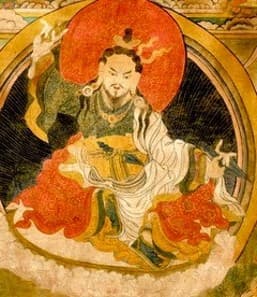
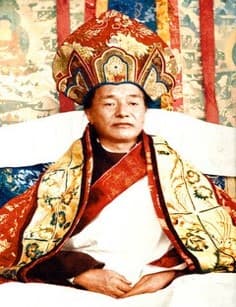
Dudjom Tersar (The New Treasures of Dudjom), is a collection of revealed terma (hidden treasures) by two great Tertön Kings: H.H. Dudjom Lingpa (1835-1904) and H.H. Dudjom Rinpoche (1904-1987). Alongside the Longchen Nyingthik, Dudjom Tersar has become one of the most widespread terma cycles among Nyingma practitioners, both monastic and lay. Within the vast array of practices, the Chöd and Tröma Nakmo cycles are particularly popular among Dudjom Tersar practitioners.
PROPHECY

Urgyen Dechen Lingpa prophesied: "In the future in Tibet, to the east of the Nine-Peak Mountain, in the sacred land of Vajravarahi, there will be an emanation of Drogben, of royal descent, named Jnana. His Dharma activities to benefit sentient beings will accord with the Vajrayana, although his conduct will be unconventional and unexpected like a young boy with astounding wisdom. He will reveal new termas (hidden treasures) or protect and preserve older termas."
Anyone who has a karmic connection with Him will be guided to the pure land of the Copper-Colored Mountain, Zangdok Palri.
SIGNS OF ACCOMPLISHMENT
In the Dudjom Tersar lineage, there are three particularly widespread cycles of practice:
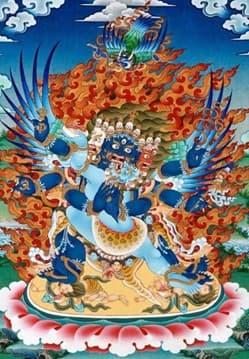
Dudjom Vajrakilaya
This is the most powerful practice for removing obstacles and subjugating demonic forces.
Signs of accomplishment:
Body: The practitioner may feel extraordinary physical strength or physical signs.
Speech: Hearing the resounding syllable HUNG from the sky, trees, or mountains. Speech becomes powerful, capable of magnetizing and healing.
Mind: Realization of emptiness inseparable from compassion. A special sign is the amrita (Tse-chang) in the offering bowl or torma naturally boiling over during the practice.
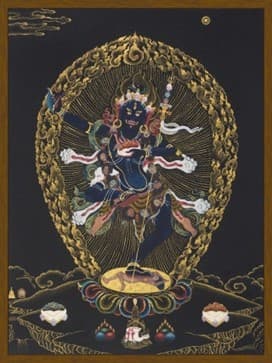
Dudjom Tröma Nakmo (Wrathful Black Mother)
This cycle is the essence of Chöd (Cutting through ego) practice, leading the practitioner to swift enlightenment.
Signs of accomplishment:
Rainbow Body: This is the highest sign. Historically, 13 disciples of Dudjom Lingpa attained the Rainbow Body through this practice.
Visions: The practitioner directly beholds the form of Tröma Nakmo or receives prophecies from the Dakinis.
Bliss: A feeling of great bliss and freedom, with no remaining attachment to the physical body or the ego.
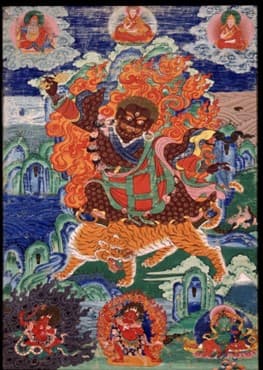
Dudjom Guru Dorje Drolö (Wrathful Guru Dorje Drolö)
This is the wrathful manifestation of Guru Rinpoche to subjugate fierce spirits and transform adversity.
Signs of accomplishment:
Transforming adversity: Obstacles, diseases, and evil spirits in the practitioner's area are subjugated and transformed into favorable conditions.
Spiritual power: Prophetic or clairvoyant abilities emerge. When Dudjom Rinpoche practiced this at Paro Taktsang (Tiger's Nest), He received "mind treasures" (Gongter) and auspicious signs like falling flowers and wondrous lights.
"During the time of Dudjom Lingpa, according to the oral traditions of the lineage and prophecies in His biography, through the Tröma Nakmo practice, 13 of Dudjom Lingpa's disciples attained the rainbow body, and a thousand achieved the level of Vidyadhara (Knowledge Holder)."
In the 20th century, reports state that some of Dudjom Rinpoche's disciples attained the rainbow body, among them Khenpo Acho and Jigme Choying Norbu.
STAGES OF PRACTICE
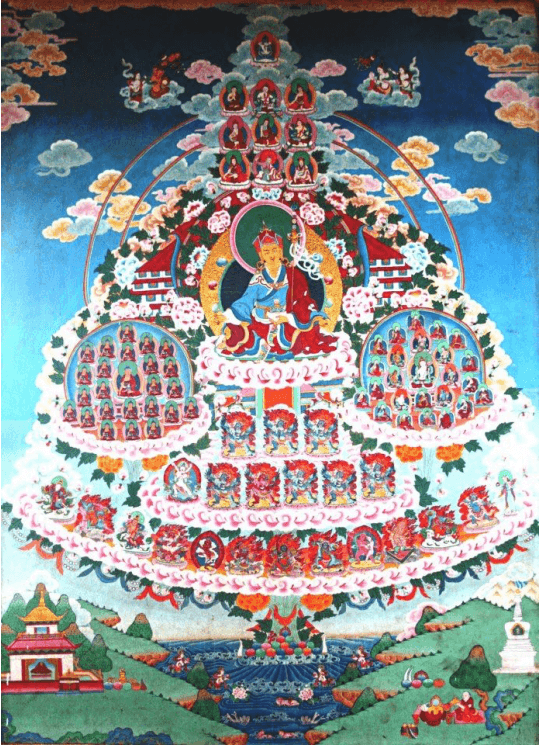
Dudjom Tersar is a complete path to Liberation:
Dudjom Tersar Ngöndro (Extremely Concise Version)
This is the most popular text in the world today of the Dudjom lineage, composed by H.H. Dudjom Rinpoche Jigdral Yeshe Dorje himself.
Đặc điểm
Concise and condensed, yet contains all 5 fundamental parts (Refuge, Bodhicitta, Mandala Offering, Vajrasattva, and Guru Yoga).
Đối tượng
He composed this specifically for busy modern practitioners, helping them maintain a daily practice schedule while still receiving complete blessings.
Ý nghĩa:It is considered "fast and powerful" like a lightning bolt, helping the practitioner connect directly with the master's mind.
Khandro Thugthig Ngöndro (Heart Essence of the Dakini)
This is the Ngöndro system belonging to the Khandro Thugthig teaching cycle – a terma (treasure) focused on the enlightened feminine principle.
Đặc điểm
The focal point of this practice is Yeshe Tsogyal (the Mother of Tibet).
Sử dụng
Usually practiced by those with a deep connection to Dakini lineages or those wishing to purify inner energy obstacles.
Ý nghĩa:It helps the practitioner awaken the energy of innate wisdom (Dakini) within. It emphasizes compassion and the insight into Emptiness through the form of the Mother Buddha.
Tröma Nakmo Ngöndro (Wrathful Black Mother)
This is the prerequisite for those wishing to dive deep into Chöd (Cutting through ego) practice – one of the most quintessential practices of the Dudjom lineage.
Đặc điểm
Tröma Nakmo is an extremely wrathful deity, representing the wisdom that severs all clinging to the "I".
Dấu hiệu
Practitioners of Tröma Ngöndro often experience very rapid mental transformation, cutting off hope and fear in daily life.
Ý nghĩa:This practice is highly effective in eradicating deep-seated fears and heavy negative karma.
Although the ultimate goal is to purify the mind to enter Dzogchen (Great Perfection), having 3 systems helps accommodate different capacities:
Dudjom Tersar Ngöndro
For general, persistent daily practice.
Khandro Thugthig
For those wanting to develop wisdom and devotion through the form of the Mother Buddha.
Tröma Nakmo
For practitioners with great courage, wanting to directly confront and decisively destroy the ego.
To practice any of the 3 systems above, you need:
Lung (Oral Transmission):Hearing the text read by a teacher with a pure lineage.
Wang (Empowerment):Permission and blessing to practice (especially for Tröma and Khandro Thugthig).
Tri (Instruction):Detailed guidance on visualization and recitation.
HÀNH TRÌNH TỚI GIẢI THOÁT
Kyerim (Development Stage)
with the sadhanas of Guru Rinpoche, Guru Dorje Drolö, Vajrakilaya, Yeshe Tsogyal, Senge Dongma, etc.
Dzogrim (Completion Stage)
with instructions on Tsa-Lung
Dzogchen (Great Perfection)
with the practice of Trekchö — the main text being Nang Jang — and Tögal.
THE TANTRAS
Dudjom Lingpa revealed five Dzogchen tantras:
1. Sangtri Kagyama
This is the root tantra. Full name: Chönyid Kanyam Dzogpa Chenpo (The Great Perfection of the Natural Equality of Dharmata). This is the foundation (Root) of the entire system. It establishes the correct View of the nature of mind. "Kagyama" means "sealed", indicating the highly secret and precious nature of this teaching.
2. Neluk Rangjung (The Self-Emergence of the Natural State)
This tantra focuses on Neluk (The natural state). It explains how reality is inherently self-existing, unelaborated. It helps the practitioner realize that enlightenment is not something coming from outside, but an inherent state that naturally appears when obscurations are cleared.
3. Magom Sangye (Buddhahood Without Meditation)
Full name: Gongpa Zangthal (The Penetrating Insight of the Enlightened Mind). This is one of the most "earth-shattering" teachings. "Ma-gom" means "no meditation". It points out that if one recognizes the nature of mind instantly, they attain Buddhahood without needing to undergo prolonged stages of ascetic training. This is the pith of the Trekchö (Cutting Through) practice.
4. Dagö Japu Chen (The Great Net of Natural Light)
Focuses on the manifestation of wisdom light. It describes visions and how enlightened wisdom interacts with the phenomenal world. It guides the practitioner on how to transform mistaken perceptions into pure pristine purity.
5. Sherik Dorje Nönpo Gyü (The Tantra of the Sharp Vajra of Conscious Awareness)
Commonly called: The Sharp Vajra Tantra. This is the most important volume for many Dudjom practitioners. H.H. Dudjom Lingpa received it directly from Samantabhadra in a profound vision. The text is a direct dialogue between the Mind (Student) and Innate Wisdom (Teacher). It "cuts" through all doubts and misunderstandings about the nature of mind with razor-sharp vajra wisdom.
THE SADHANAS
According to the oral instructions of the lineage holders, the Guru, Yidam, and Dakini practices of the Dudjom Tersar lineage are practiced as follows:
1. Lama (Guru)
a. outer: Orgyen Menla Dütsi Bum Zang; b. inner: Lama Orgyen Khandro Norlha; c. secret: Tsokye Tuktik (Lake-born Vajra) – a mind terma of Guru Rinpoche; d. innermost secret: Dudjom Traktung Pema Sokdrub.
2. Yidam
a. Pudri Rekpung; b. Namchak Pudri.
3. Dakini
a. outer: Khandro Tuktik, a mind terma based on Yeshe Tsogyal; b. inner: Kurukulle; c. secret: Senge Dongma; d. innermost secret: Tröma Nakmo (The Wrathful Black Mother).
4. Other practices
Chime Soktik is a long-life practice based on Amitayus in the Dudjom Tersar lineage; Dechen Namrol is a Guru Rinpoche practice, similar to Rigdzin Düpa.
PROPHECY
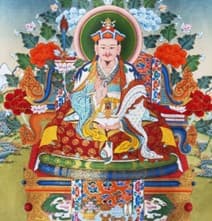
When Dudjom Rinpoche was 8 years old, he began studying the Bodhicaryavatara with his teacher Ling Lama Chojor Gyatso. Upon finishing the first chapter, his teacher handed him a conch shell and told him to blow it towards the four directions. The sound of the conch when blown towards the east and north was quite short, but when blown towards the south it was longer, and when blown towards the west it was even longer. That was a sign indicating in which directions his future Dharma propagation would be strongest.
LINEAGE HISTORY
During the time of Dudjom Lingpa, the Dudjom Tersar lineage developed primarily in the Golok (Amdo) and Kham regions of Tibet. Later, the principal direct disciples of Dudjom Lingpa spread the Dudjom Tersar lineage across various regions of Tibet.
Subsequently, in the first half of the 20th century, Dudjom Rinpoche developed the lineage at Khorlo Dratsang in Pemako, where he was born, and later at Lama Ling, his seat in Southern Tibet. From 1959 onwards, Dudjom Rinpoche propagated this lineage first in India, then in Himalayan kingdoms such as Bhutan, Sikkim... and later in Europe, the USA, East Asia, etc. Today, the Dudjom Tersar lineage is present all over Tibet, India, Nepal, and Bhutan.
1. The Period of Origin (19th Century - Early 20th Century)
• Location: Golok (Amdo) and Kham (Eastern Tibet). • Context: This was the homeland of H.H. Dudjom Lingpa. Here, He revealed termas and taught thousands of disciples, among whom 13 attained the Rainbow Body. The lineage at this time had a secret yogic character, concentrated in high mountains and local monasteries.
2. The Period of Systematization (First half of the 20th Century)
• Location: Pemako and Lama Ling (Southern Tibet). • The Role of Dudjom Rinpoche II: He was born in Pemako (the prophesied sacred land). At Lama Ling monastery, He gathered the teachings of his predecessor and turned the place into the largest center for study and practice of the Dudjom lineage at the time.
3. The Period of Global Expansion (From 1959 to present)
The political events in Tibet unintentionally became an auspicious condition for this lineage to go out into the world: • In India & the Himalayas: He established practice communities in Kalimpong and Orissa (India). In Bhutan, the Dudjom Tersar lineage is extremely flourishing and revered by the royal family (propagated by His sons like Thinley Norbu Rinpoche). • In the West: Dudjom Rinpoche was one of the first masters to bring Vajrayana to France and the USA. He founded the Dorje Nyingpo center (Paris) and Yeshe Nyingpo (New York). • Today: The lineage is present in East Asia (Taiwan, Hong Kong, Vietnam), Russia, and across Europe.
The "Family" Nature: Dudjom Tersar is often maintained through both forms: Transmission via reincarnations (Tulkus) and bloodline transmission (Family lineage). The descendants of Dudjom Rinpoche (such as the masters of the Dungse family) play an extremely crucial role in preserving the purity of the lineage.
The Combination: This lineage is famous for smoothly integrating the lay life (householder practitioners achieving high realization) and the ordained monastic life.